







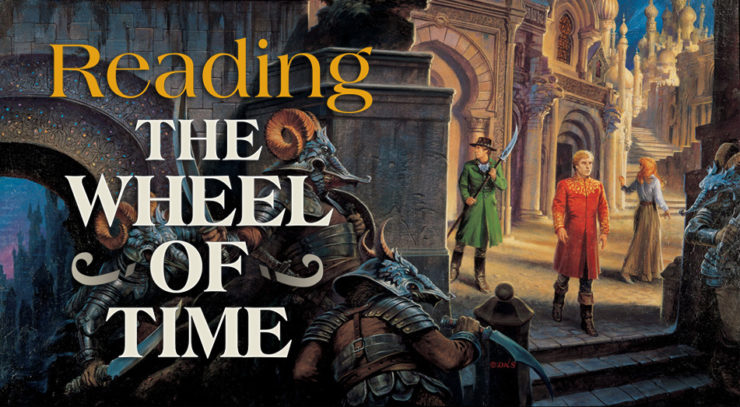
Welcome back to Reading The Wheel of Time. This week we’re covering chapter 51, and once again (if you will permit a mix of idioms) I have been hoisted by my own hubris in assuming that I could cover two chapters this week. Come on Sylas, you knew how complex the chapters are getting! We’re nearing the climax of The Fires of Heaven, after all, which is fast shaping up to be another couple chapters of Rand chasing a Forsaken while they hurl saidin at each other.
Speaking of idioms, one of Egwene’s comments in this chapter sparked my descent down a google rabbit hole this week. When Rand declares his intention to go after Rahvin, she asks him if he’s going to draw a line in the sand for Rahvin to step over, or put a chip on his shoulder. Of course I’m familiar with the meaning of the phrase “a chip on [your] shoulder” but it had never occurred to me to wonder where the expression came from. So I googled it, and while I found a few conflicting answers, the most common origin explanation was that people who wanted to fight, usually over a personal difference or grievance, would put a chip of wood on their shoulder and dare the person they were upset with to knock it off. If the person did, then they would brawl.
It was unclear to me how big the chip of wood is supposed to be; a few sources made it sound like it was a full piece of timber, which sounds wild, and has now firmly planted the imagine in my head of Rand throwing a two-by-four over his shoulder and daring Rahvin to knock it off with saidin.
In any case, I learned something about history today, which is a really cool part of reading. Jordan didn’t set out to teach me this little nugget, and there’s a lot more important stuff going on with Rand and co, but I still got something extra from this week’s read.
But let’s get to that other important stuff now, and begin the recap.
Chapter 51 opens on a balcony in the Palace in Cairhien, where Rand has come out to smoke and get away from the meeting he’s been having. Unfortunately a young noblewoman named Selande has followed him out, and Rand’s having a hard time ignoring her while she presses her body suggestively up against him.
He thinks about the sweltering heat, and how both Asmodean and Moiraine have agreed with Rand’s assessment that it’s not natural weather but could not offer him any idea of how it is happening or what he can do about it. He also thinks about Sammael, wondering when “the next taunt” will come and reminding himself that he will not react until he is ready. He is methodically building up Tear so that he can take Illian in one stroke, taking care of Sammael and adding to his own power and control.
Buy the Book
The Witness for the Dead
But his thoughts are continually interrupted by Selande trying get him to go swimming with her, to escape the heat in private, and finally he turns and begins to talk to her about how he can channel. He implies that he’s interested in her while talking about the taint on saidin and the madness it brings, until he finally bends to kiss her and she scurries away in terror.
With a grimace, he turned back to the railing. Frightening women. She would have made excuses had he asked her to leave him, would have taken a command as only a temporary setback unless it was to stay out of his sight, and even then… Maybe word would spread this time. He had to keep a short rein on his temper; it ran away too easily of late.
He wonders why anyone would want to rule a nation when they could do something easier, like try to carry water uphill in a sieve.
Rand considers the banners flying over the city, and then the city itself, bursting with refugees and Hunters for the Horn, merchants and soldiers, even Ogier looking for work. He’s glad that the supplies from Tear are finally arriving regularly. There are plenty of other things to worry about, however, like how most of the chiefs he trusts have been sent to Tear or elsewhere, and although the four new clans have acknowledged him as the Car’a’carn, he doesn’t know them, and they don’t know him. He’s also learned that Berelain is on her way, along with a small army—she sent a letter ahead, no doubt to remind Rand that Mayne exists, and for some reason to ask if Perrin is with him. He wonders if he should leave Berelain in charge when he leaves, then goes back inside.
In the meeting room, the Tairen (Meilan, Torean and Aracome) are arranged on one side and the Cairhienin on the other (Dobraine, Maringil, and Colavaere, as well as Selande). Rand sits in a chair that has been gifted to him by the three Cairhienin, which he guesses is so gaudy because they assume he has the taste of a Tairen. Rand also notes a new level of wariness in the Cairhienin’s eyes, and wonders if his treatment of Selande has reminded them of who he really is, that they can’t pretend he’s just some young lord who has conquered them.
They discuss Rand’s deployment of troops, arguing about where they are most needed, and Maringil brings up the fact that Andor is occupying half the Cairhienin land west of the Alguenya River.
Morgase does not seem to be reaching for more as yet, but what she has already must be taken back. Her heralds have even proclaimed her right to the—” He stopped abruptly. None of them knew who Rand meant the Sun Throne for. Maybe it was Morgase.
Rand feels exhausted by all the maneuvering of nobles playing Daes Dae’mar, and flatly reiterates his orders and decisions. He threatens to ride out and check that Meilan and Aracome’s troops are where Rand ordered them to be. They assure him that he’ll find everything correct. Rand is sure he will—because after the threat the troops will be hastily moved.
He dismisses everyone except Colavaere, who is the person responsible for continually trying to entice him with young women. He tells her that Selande is pretty, but he prefers a more mature woman and informs her that she will join him for dinner tonight. When she’s gone, he laughs at the fact that he’s disgusted with Daes Dae’mar and playing it without thinking. He knows that Colavaere wants to provide the Dragon Reborn with a “bed partner” to tie a string to him, and he hopes Colavaere will, after having to wait to suffer through anxiety and fear about their dinner together, will be amenable to dropping the whole thing. Of course, she might think being with him worth the possible benefits, and then he’ll just have to scare her the way he did with Selande. He thinks about saidin, the taint, and how he sometimes believes he can feel the taint even when he’s not embracing saidin.
He notes that Asmodean, who has been playing his harp in the corner and suiting the music to the mood all evening, has stopped and appears to be studying Rand. Rand glares at him, and Asmodean starts playing a soothing tune.
Moiraine, Egwene and Aviendha, the only people that the Maidens outside would allow to enter without challenge, come in without knocking. Egwene glares at Natael, but Rand just tells her that he’s surprised to see her, accusing her of avoiding him and making a sarcastic remark about all the “good” news she’s been bringing him, maybe of Masema sacking Amador in his name or the Aes Sedai who are supposedly supporting him have all turned out to be Black Ajah. He points out that he doesn’t ask how she knows, and that she should just give him the driblets of information she’s willing to dole out.
Egwene calmly answers him that she tells him what he needs to know, and not what he doesn’t need to know, and Rand asks what they want. Moiraine hands him two letters, and Rand complains why they didn’t come directly to him, until Moiraine points out that they are from the White Tower. She also primly informs him that they aren’t concealing poisoned needles or traps woven with saidar, neither of which possibility had occurred to Rand.
The first letter is from Elaida, which acknowledges who Rand is and tells him to accept the shelter and protection of the White Tower, which will ensure that he lives to see Tarmon Gai’don. It also says that an escort of Aes Sedai will come to bring Rand to Tar Valon “with the honor and respect that you deserve.” Rand notes wryly that she doesn’t even ask, and is privately certain that the escort will consist of thirteen sisters.
He passes the letter to Moiraine and opens the other, finding a much less perfunctory letter, full of flattery and praise and warning him that his “splendor will inspire jealousy even in those not toiled in the Shadow,” even in the White Tower itself. The letter writer professes herself as ready to “kneel and bask in his brilliance” and warns him against trusting Moiraine. It finishes;
Yet even if you believe she is your creature, as I, I beg you to keep this missive secret, even from her. My life lies beneath your fingers, my Lord Dragon Reborn, and I am your servant. — Alviarin Freidhen
Rand passes it to Moiraine, and the three women look over it in turn. Egwene murmurs to herself that Alviarin must have heard about Rand’s swelled head, but then observes aloud that the letter doesn’t sound like Alviarin at all. Moiraine asks what Rand thinks of the letters, and Rand observes that there is a rift in the Tower, as he can’t think of Elaida believing half of what Alviarin wrote, or knowingly having a Keeper who thought that way. When asks what else he sees, Rand adds that the swiftness of these letters’ arrival proves that there are White Tower spies in the city, reporting on him.
Moiraine smiles at him, almost fondly, and tells him that he has learned quickly, and will do well. Rand tells them that he’s not going to do anything about the spies other than make sure that Elaida’s escort doesn’t get within a mile of him, and remember that the Tower knows what he’s done the day after he has done it.
Mat arrives, announced by Somara, and Rand tells Moiraine, Egwene, and Aviendha to stay because he knows that their presence will put Matt off balance. When Mat strolls in, he’s grinning and disheveled, claiming that he’s late to Rand’s summons because some Cairhienin wanted to play cards. Rand observes that he’s heard every young man who can pick up a sword wants to join the Band of the Red Hand and Mat awkwardly agrees about young men wanting to be heroes.
“The Band of the Red Hand,” Moiraine murmured. “Shen an Calhar. A legendary group of heroes indeed, though the men in it must have changed many times in a war that lasted well over three hundred years. It is said they were the last to fall to the Trollocs, guarding Aemon himself, when Manetheren died.”
Mat answers that he doesn’t know about any of that, someone just started using the name, but Moiraine presses on, talking about how brave Mat is, referencing all the battles he and his men have been in, with small losses on Mat’s side despite being outnumbered. She wonders aloud if he is drawn to battles, or if the battles are drawn to him, and Rand watches silently as she scares his friend. Mat snaps at her prodding, telling her to say what she wants to say, and Moiraine responds coolly that they all have to do what the Pattern decrees, and some have less choice than others.
Mat responds that she always has to lead or kick a man where she wants him, and Elayne, Nynaeve, and Egwene too. But when he mentions that he’s glad that Elayne isn’t there to hear the news, Rand interrupts him sharply to ask what news he’s talking about. Mat tells him that Morgase is dead, prompting shock from everyone in the room except Asmodean.
Rand felt as if his belly had been ripped out. Elayne, forgive me. And a faint echo, altered. Ilyena, forgive me. “Are you certain?”
Mat explains that he’s as certain as he can be without seeing a body, and explains how Morgase has supposedly named Gaebril King of Andor. But there have been rumors that she hasn’t been seen in weeks, and Mat did warn Elayne that Gaebril wanted her killed. It’s clear to Mat what all that adds up to, and he doesn’t believe that Gaebril would hesitate to slit a queen’s throat.
Rand finds himself sitting across from Mat, Aviendha gripping his shoulder, although he doesn’t remember moving there. He thinks that Elayne will never be able to forgive him—he had known that Rahvin held Morgase prisoner but hadn’t gone after her because he thought the Forsaken might expect it. And then he’d gone chasing after Couladin instead of his original plan, and had been distracted by Sammael’s taunts. He thinks to himself that Elayne will curse him to his deathbed, as Mat goes on to talk about how many queen’s men there are, and how half of them will rally to Elayne if Rand puts her on the throne.
“Shut up!” Rand barked. He quivered so hard with fury that Egwene stepped back, and even Moiraine eyed him carefully. Aviendha’s hand tightened on his shoulder, but he shook it off as he stood. Morgase dead because he had done nothing. His own hand had been on the knife as surely as Rahvin’s. Elayne. “She will be avenged. Rahvin, Mat. Not Gaebril. Rahvin. I’ll lay him by the heels if I never do another thing!”
Mat curses, and Egwene cautiously reminds him that he has his hands full with Cairhien, the Shaido, and whatever he’s doing in Tear. But Rand assures her he’s not starting another war—he’s just going by himself. It’s a raid, and he could wish he had Elaida’s thirteen sisters to smother Rahvin so that they can try and hang him for murder, but since he doesn’t Rand will just have to kill him however he can.
Moiraine says “tomorrow” softly, and although Rand glares at her he knows she’s right. He needs to let his rage cool, right now he just wants to lay about with saidin and wreck things.
Asmodean has changed his music again; now he’s playing a song that street musicians were playing during the Cairhien civil war, called “The Fool Who Would Be King.” Rand snaps at him to get out.
Asmodean straightened smoothly, bowing, but his face could have done for snow, and he crossed the room quickly, as if uncertain what one second more might bring. He always pushed, but perhaps this time he had pushed too far. As he opened the door, Rand spoke again.
“I will see you tonight. Or I will see you dead.”
Asmodean bows again, less composedly this time. Rand tells the rest of them to leave, except Mat. But the women don’t go. Instead Aviendha reminds him that, while he doesn’t have thirteen Aes Sedai, he does have two, as well as someone who is as strong as Egwene and no stranger to the dance. Rand answers that Rahvin is his, and Egwene demands if he has considered that Rahvin might have backup. Rand pretends that he hadn’t intended to go alone, even though he was thinking exactly that, and realizes that his anger is making it impossible to think clearly. He says that Moiraine may come, but that it’s too dangerous for Egwene or Aviendha.
“Moiraine can come if she wishes,” Egwene said.
If her voice was smooth ice, Aviendha’s was molten stone. “But it is too dangerous for us.”
“Have you become my father? Is your name Bran al’Vere?”
“If you have three spears, do you put two aside because they are newer made?”
Moiraine adds that there may be one or more of the female Forsaken with Rahvin, and Rand notes something odd in her voice when she says Lanfear’s name. Rand relents and says they can come, and remarks to Moiraine that she didn’t try to talk him out of it.
“The Wheel weaves as the Wheel wills,” was Moiraine’s reply. She stood in the doorway looking more Aes Sedai than he ever remembered her, ageless, with dark eyes that seemed ready to swallow him, slight and slender yet so regal she could have commanded a roomful of queens if she could not channel a spark. That blue stone on her forehead was catching the light again. “You will do well, Rand.”
Mat tries to sneak out again and Rand stops him, interrupting Mat’s usual protests about not being told what to do and not being a hero, even shouting at him to shut up. He reminds Mat that he was there when Mat got his foxhead medallion and the knowledge in his head. Rand needs that knowledge, Mat’s knowledge of war. He begins to explain what Mat and the Band of the Red Hand are going to do.
Outside in the hall, Moiraine warns Egwene to be careful. Egwene assures her that she knows how dangerous facing one of the Forsaken will be, but Moiraine repeats for her to be careful, and that Rand will need her and Aviendha—people who can’t be driven away by his rages and who will tell him what he needs to hear, not just what he wants to hear—in the days to come. Egwene responds that Moiraine does that.
Egwene asks Aviendha to stay with her for a while, but Aviendha replies that she must fill Amys in on what’s happening. She asks if the Aes Sedai in Salidar will really help Rand, and Egwene urges her to be careful with that name—Rand can’t be allowed to find them until he’s been prepared for the encounter.
The way he was now, they would be more likely to gentle him, or at least send thirteen sisters of their own, than help him. She would have to stand between them in Tel’aran’rhiod, she and Nynaeve and Elayne, and hope those Aes Sedai had committed themselves too far to back out before they discovered how near the brink he was.
Aviendha promises to be careful, and counsels Egwene to get a good meal and a good night’s rest but not to eat in the morning, because it’s not good to dance the spears on an empty stomach. Egwene privately thinks that she probably can’t eat at all, and worries about Lanfear or another Forsaken being at Rahvin’s side. She also thinks about how frightening it is when she sees another man peering out of Rand’s eyes, or hears another man’s words come out of his mouth.
It should not be so; everyone was reborn as the Wheel turned. But everyone was not the Dragon Reborn. Moiraine would not talk of it. What would Rand do if Lanfear was there? Lanfear had loved Lews Therin Telamon, but what had the Dragon felt for her? How much of Rand was still Rand?
She tells herself firmly that she’ll just work herself up thinking this way, and makes herself eat her dinner, even though it tastes like ashes.
Meanwhile, Mat stalks through the palace to the chambers that have been set aside for him, fuming over the way his conversation with Rand went. No matter which way he turned Rand trapped him, and even if Mat did try to ride out, Talmanes and Nalesean would just follow him again, and Mat would find a battle for them because Moiraine was right—battles seem to be drawn to him. He really has no choice but to do what Rand wants.
He imagines aloud announcing to the High Lords that he, a gambler and a farmboy, has arrived to take command of their army and hurls his spear across the room, splitting a tapestry. The blade isn’t harmed by hitting the wall though, being Aes Sedai work.
From the doorway, Melindhra asks what that was, and Mat asks if Kadere has found any ships yet—all the Aiel go down to look at the river sometimes, but Melindhra has been going every day. She reports that the wagons are still there, and asks him why he wants to know.
Mat tells her that he is going away for a while, on Rand’s orders, and that of course he would take her with him but she wouldn’t want to leave the maidens. He’s surprised when Melindhra is upset, not because he’s not taking her with him but because he’s going to “slip back into Rand al’Thor’s shadow.” She tells him that he has already earned his own honor, not honor reflected from the Car’a’carn.
“He can keep his honor and take it to Caemlyn or the Pit of Doom for all I care. Don’t you worry. I’ll find plenty of honor. I will write you about it. From Tear.” Tear? He would never escape Rand, or Aes Sedai, if he made that choice.
“He is going to Caemlyn?”
Mat winces internally—he knows he’s not supposed to let Rand’s plans slip to anyone—and tries to make it sound like he just pulled a name at random. He’s completely unprepared for her to suddenly attack him, kicking him in the gut and then in the head, leaving him foggy. When he is able to see again he finds himself on his back across the room, and Melindhra is arming herself with a dagger and veiling her face.
Groggily, he moved by instinct, without thinking. The blade came out of his sleeve, left his hand as if floating through jelly. Only then did he realize what he had done and stretch out desperately, trying to snatch it back.
The hilt bloomed between her breasts. She sagged to her knees, fell back.
Mat crawls over to her, tugging her veil aside and demanding why as she, bizarrely, smiles up at him and tells him that she always liked his pretty eyes. Again, he demands to know why.
“Some oaths are more important than others, Mat Cauthon.” The slim-bladed knife came up swiftly, all her remaining strength behind it, the point driving the dangling foxhead against his chest. The silver medallion should not have stopped a blade, but the angle was just that much wrong, and some hidden flaw in the steel snapped the blade off right at the hilt just as he caught her hand. “You have the Great Lord’s own luck.”
Mat asks why a third time, but she’s already gone. Mat covers her face with her veil, struggling with the knowledge that he’s never killed a woman before. He pulls the knife from her hand and hurls it into the fireplace, hoping it will shatter, his thoughts spiraling. When he forces himself to think, though, he realizes that she had said “The Great Lord” and that her knife had golden bees on it—the sign of Illian and therefore of Sammael. But it seems ridiculous that Sammael would be afraid of someone like Mat, and as much as Mat doesn’t want to admit to the fact that Melindhra was apparently a Darkfriend and working for Sammael, he isn’t a fool.
One of the Forsaken had noticed him. He certainly was not standing in Rand’s shadow now.
Okay, so of course I’ve already finished Chapter 52 and know what’s coming, but I have been suspecting that Moiraine was going to die in this book since she started getting so desperate for Rand to listen to her, when she was willing to go so far as swear obedience to him. And if I’d had any doubts about whether that suspicion was right, this chapter would have definitely quashed them. That moment when Rand is watching her and thinking about how queenly she looks. The way she tells him that he’s going to do well. The way she reminds Egwene and Aviendha of the things they need to do to look out for Rand… yeah.
And then there’s the way Rand keeps noticing when the blue stone Moiraine is wearing catches the light. I wonder if there’s a particular reason to draw narrative attention to the stone (is she doing something with it in those moments?) or if it’s just a reminder of her identity and her power.
It’s a nice subtle clue of what’s to come when Rand notices the odd tone to the way Moiraine says Lanfear’s name. If I had been just reading for pleasure I might not have noticed it, but I could see myself coming back to it later. And in any case, I caught it in my analysis and it is making me think a lot about what it must be like for Moiraine to see whatever signs she’s seeing, to know that this moment is coming for her. It’s giving me a lot of feelings.
Moiraine has sacrificed so much already, and here she stands on the verge of a death she knows is coming, carrying that self-possession and quiet stillness that comes with having made her choice. People often throw around the term “ultimate sacrifice” when talking about the death of soldiers in battle, and I think the phrase can sometimes be misused or over-used, because it implies more choice that is often available—just because someone accepts the risk of death as a soldier doesn’t mean they chose to die, if that makes sense. But this moment with Moiraine reminds me of that phrase; she has seen the future and been able to choose her path, and was willing to sacrifice herself for the world, and the Light.
I actually thought Moiraine was going to die in The Eye of the World. She was the Gandalf of the group, the Wise Guide character who has to be removed from the hero’s journey at some pivotal moment so that he can fully come into his own choices, and his own power. But she and Thom were sort of sharing that role back in The Eye of the World, especially since Rand and the boys didn’t trust or confide in Moiraine back then and Thom got his Gandalf moment when everyone thought he’d been killed by that Myrddraal. Now Moiraine has had more time to influence, teach, and prepare Rand for the future, and her moment to be dragged down by a Balrog has finally come.
(Yeah, I called Lanfear a balrog. And I stand by it.)
But let’s focus on Rand for a moment, who has the bulk of the POV in this lengthy, conversation-filled chapter. There is a lot going on with him in this chapter. I am both fascinated and frustrated trying to guess what part of his thoughts is being influenced by the taint on saidin and what is stress and exhaustion and desperation. The way he treats Selande and Colavaere seems to be born out of desperation—he doesn’t believe anything less intense will be successful, and has decided that it’s better to terrify the women than to let Aviendha beat them up. But one has to wonder if the cruelty, the willingness to suggest to them that he is willing to assault or even rape them, isn’t made a little easier or more appealing by the taint that is seeping into the cracks in his mind. The same goes for his rage.
Rand has plenty of justification for being as angry as he is, after all. He’s constantly experiencing pain and loss and facing an endless array of nigh-impossible tasks. He has the literal fate of the world resting on his shoulders. And since he loves Elayne, his anger at Rahvin is personal as well as moral. There is also fear, and guilt. That’s a lot for anyone to handle.
And of course, Rand is an incredibly powerful person, so the weight of his anger is greater and more threatening than almost anyone else in his world. It can seem out of proportion to those encountering it, and even to the reader, because we know what the consequences are of Rand losing control. We know how important it is for him not to lash out at anyone, and we see that Rand is aware of it too.
You know, when I began this section I really wasn’t sure if I thought the taint had any bearing on Rand’s reaction to hearing of Morgase’s death, but I think I’ve convinced myself that it wouldn’t be any different even without the thread of madness that has reared its head in Rand from time to time. Still, it is possibly a factor, and I imagine that his friends are wondering if it is, especially since they can’t follow his train of thought about Elayne’s possible reaction, or see how personally guilty Rand is taking the news.
Egwene’s section in this chapter was a good reminder to me how different Rand must look to those around him from how he does to the reader. I’m having a hard time sorting out what’s going on in Rand’s mind, what is him or Lews Therin or just the taint eating away at his sanity, but that’s because Rand doesn’t always know either. I still have a lot more context than Egwene or anyone else does. All she sees is a man who was her childhood friend, who has changed so intensely over the past few years that he must seem almost unrecognizable to her even when Lews Therin isn’t peering out from behind Rand’s eyes, as she puts it in her own thoughts. It’s easy to get annoyed by Egwene’s constant insistence that Rand is getting a big ego when she can’t be in his mind the way we can, can’t see his agony over the people he can’t save and his wish that he didn’t have to carry the weight and responsibility that comes with being a leader and a ruler. But she does care about Rand very much, and is always trying to protect him and keep him safe; she wonders if she’s keeping Aes Sedai or Wise Ones secrets, but he doesn’t know how many of his secrets she is keeping from them.
You know, it must be weird for Egwene. Everything she has tried to learn and accomplish has come with a caveat that isolates her from others. She is keeping secrets for the Wise Ones but also from them, secrets for Moiraine and also from her. Secrets from Rand, but also for Rand. She might be the character who is pulled in the most disparate directions, even more so than Mat is by the Pattern. And Rand is not very fair to her about it—he hates himself for the way he uses people, but he’s also suspicious and bitter about any of the powerful women around him doing the same thing. So maybe he does kind have a swelled head after all.
And maybe that’s part of the taint, or the Lews Therin persona too. When Rand first started hearing Lews Therin in his head, I assumed this was a normal part of being the Dragon Reborn, that the previous Dragon might come through to speak to you and give you advice, the way the previous Avatars do in Avatar: The Last Airbender and Avatar: The Legend of Korra. But that really doesn’t seem to be the case, and although Rand may get the occasional useful bit of information from Lews Therin, it seems like he’s also in danger of that personality doing more than distracting him in a pivotal moment—it’s almost like Lews Therin is trying to take over at times. So the bleed-through must be an effect of the taint. Just because it’s really Lews Therin’s mind with actual, factual memories doesn’t mean it’s natural, which is what I had originally assumed.
In any case, I got a little pleasure and satisfaction when Egwene pondered the same question I’ve been pondering; she doesn’t know if this is something that is part of being the Dragon Reborn.
Speaking of Aes Sedai secrets, I really thought Alviarin played her hand badly in that letter. Maybe she thinks Rand is stupid and too full of himself to be suspicious of flattery, or that he doesn’t confide in anyone ever, but you’d think she wouldn’t want to play her hand so strongly. Rand would be justifiably suspicious of a powerful Aes Sedai groveling to him no matter what his relationship with Moiraine is like—it’s definitely not their usual move. And while it would certainly be a triumph for the Black Ajah if she could make him trust her over Moiraine, given the fact that she’s a stranger to him, while Rand and Moiraine have an existing relationship, it seems a pretty desperate gamble—sure it could work, but it seems more likely that Rand would trust someone he knows over a random representative of the White Tower.
Then again, Rand tells Moiraine that it’s lucky she swore to obey him or he might be ready to suspect her. So maybe Alviarin’s gamble was a good one, but Moiraine is just one step ahead of her. Because Moiraine is the best.
I wonder what leads someone pledged to logic and reason to become a Darkfriend. I suppose one can be logical and be as greedy for power and immortality as the next woman, but you’d think the chaos of the Dark wouldn’t appeal very much. That hierarchical tendency, I guess.
Melindhra is also someone who, I feel, tips her hand a lot. She gets away with it because Mat doesn’t spend a lot of time with the other Aiel, but I think if he did he’d realize that she talks very differently about honor than the other Aiel do. There’s no shame in following a great chief, and all the Aiel, including the Wise Ones, are settled on that being Rand. I’m sure lots of Rand’s followers still have doubts—there are still the deserters and those who are struggling with the revelation of their history—but I don’t see how they could be walking around saying the things Melindhra says to Mat to each other. And one could put her attitude down to her being Shaido, of course, but then why would she leave them to follow Rand?
All in all, I’d say Melindhra is a good but not a great spy, and she gets this far mostly on Mat being oblivious and categorizing her pushing and prodding as the same as everyone else’s.
You know, Mat really is a lot like Nynaeve in some ways. He has a lot of trouble accepting the weight of duty, especially one he has not chosen, but he also has a hard time being honest with himself and his motivations. His lazy, the Dark- One-may-care attitude is a front for other people, so they don’t see his true feelings, but it’s also a way of hiding from himself. But the Pattern and his power are starting to make it harder to maintain that distance, and I think he’s getting close to a tipping point. I don’t think he’ll ever stop looking for a way out or thinking of himself as a gambler and a lover, not a soldier, but I do think he may start to accept that some of these choices are beyond his control.
And he needs to. The thing that Moiraine understands, the thing that Rand has come to understand, is that the Pattern demands things for a reason, and while there is some free will and ability to fight the direction you’re being pointed, doing so can have catastrophic results. Rand has to be there at Tarmon Gai’don, but the fate of the last battle does rest on more than his shoulders alone. Who knows what would happen if Mat managed to bend the Pattern to his own will enough to slip away. Rand might die, or lose too many battles and be unprepared for the final confrontation with the Dark One. A lot can go wrong.
Mat still makes Moiraine the scapegoat for a fate that is larger than her making, much the way that Nynaeve does. They both have to learn to see the bigger picture and the way that their lives are being driven and shaped not by one woman, but by the world itself. By their friends, by their own desires, by the Pattern. Blaming Moiraine is a cheat, and it can’t keep up.
Lucky for them, Moraine is about to be removed from their lives for good, so they are going to find themselves without that convenient scapegoat very soon.
Also, damn, Mat threw that dagger through Melindhra’s sternum? How hard did he throw it? Did his luck powers kick in, somehow bringing a bit of wind or something in to hurl it with unnatural force? Also, Jordan bringing up breasts again for no reason, at kind of a gross time. Really not necessary, sir.
I have so much compassion for Mat’s reaction though! My only complaint is that it comes off a little weird that he’s more concerned about the fact that he’s never killed a woman before than he is that Melindhra is someone he has shared a bed, and his life with, for some time. It could be shock, of course, his mind skittering away from the deeper feelings, or maybe he really didn’t have any deep emotional feelings for her, but it felt a bit squicky and sexist. A bit too much like Rand’s issues with killing women, which seem so removed from the idea of women as people.
In Rand’s case it seems to be an effect of the Lews Therin persona having trauma around Illyena’s death, of course, and we’ll see that come into play next week, but I’ll avoid speculating more on that for the time being.
Next week we’ll cover Chapter 52 and maybe 53, but I’m going to stop over promising! 52 and 53 go together though, so maybe it’s good that 51 took my whole life to finish.
Final thoughts:
I think I’d feel the same way if I was in Rand’s position, but (and putting aside the fact that we know Morgase is still alive) I don’t believe he’s right about Elayne blaming him for her mother’s death. Once she had a chance to process her grief, I think Elayne would understand the complexities Rand was operating under, and better than Rand himself does. There is too much to do, too many Forsaken all machinating and taking over kingdoms and murdering people, and Elayne knows that being a leader and a ruler means you can’t always make the choices you want, or put your personal desires first. The thing I feel like she’d be most upset about is not getting the news about Morgase’s imprisonment so that she could go help her mother herself, but I can’t remember how or when Rand found out about it, so it might have been impossible to tell Elayne anyway.
I really, really loved all the bits with Asmodean and the way he’s been matching his playing to Rand’s moods and actions. He’s not just Rand’s personal Bard, he’s like a one-man soundtrack following him around. I get why it pisses Rand off so much, but I’m kind of jealous. I want a Bard to follow me around and play music about me.
Sylas K Barrett is still wondering how big the chip is supposed to be. If anyone knows more about disgruntled people putting chips on their shoulders to start a fight and wants to tweet at him, please message @ThatSyGuy. Seriously, this may keep me up at night.
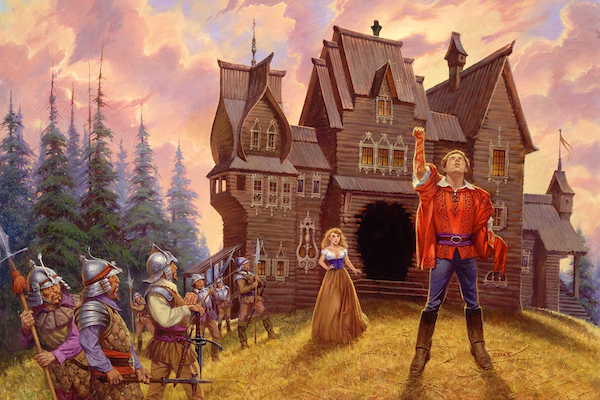

It’s sweet how Moiraine is conveying her pride and trust and yes affection for Rand as clearly as her buttoned up personality will allow.
Eggy sees herself as standing between Rand and the Salidar AS, to protect them from each other. She’s convinced there will be a damaging explosion if these two get in direct contact. She’s not wrong. Girl takes too much upon herself but one can see her point.
The important thing to remember is Rand and Lew’s Therin are the same soul. As Rand says much later he was brought up better this time so there a differences between who he was and who he is but LT is not a separate person. Rand dividing himself like that causes a lot of problems. But as Eggy says nobody should have to deal with their last life’s issues.
“A bit too much like Rand’s issues with killing women, which seem so removed from the idea of women as people.”
I see this argument a lot, and it makes absolutely no sense. Refusing to see people as people is the best way to make it *easier* to kill them. If anything, Rand ascribes far *more* value to the lives of women, which is why he has such a hard time with their deaths.
I always find it amusing that Moiraine trusts Egwene to tell Rand the things he needs to hear, instead of the things she wants to hear. I get the feeling this is RJ mistaking two different concepts. Moiraine is the person who tells it like it is, Egwene is just an asshole to Rand. She doesn’t tell him things he needs to know, or needs to hear – she needles him and tries to deflate his ego. And it’s because she takes it on herself that it comes across as false, and not geniune concern for a childhood friend. Women like Nynaeve do a far better job with this role (in regards to Rand) because that is who they are – they’re no nonsense and they speak truth to power, even when that is foolish. Egwene never comes even remotely close to that. She’s secretive and self-important, and her interactions with Rand are very much for the purpose of tearing him down and building herself up, which is why they always come across as so smug and obnoxious on her part. We never hear her advocate for the man he used to be, never hear her urge him in the ethical instead of the easy direction.
Egwene has become separated from Rand because of her own prejudices. Most of the time spent in Tear and in the Waste, she spent contrasting her own experience with what she assumed Rand was doing, and that created a separation. She joined the Wise Ones in spying on him. She’s one of those people who are capable of immense acts of selflessness and sacrifice, but only for people with whom she shares an experience or connection. Defending Aviendha to the Wise Ones? She’s a model friend and advocate. Having to run around in the cold because of it? Well, Rand isn’t there, so he must be safe and warm and doted on by the Maidens, and not dealing with assault and the misery of having the literal fate of the world on his shoulders.
Also, as a side note, since we shouldn’t lose sight of it when it happens – Selande is sexually harassing Rand here. And if she isn’t, then certainly Colavaere is, because it’s explicit that Selande is the latest in a long line of women ignoring Rand’s emphatic “no” and continuing to badger him into a liaison when he doesn’t want it. I don’t know that it justifies Rand’s response, but in a re-read where we’re all (rightly) being sensitive to where women are being thrust into uncomfortable situations, it is important to keep remembering that if Rand were a woman and Selande a man, we’d be spending a lot more time talking about how icky that scene is and would be a lot more forgiving of the person being harassed in their attempts to escape it
Rand and Mat grew up in a remote socially conservative village. Traditional gender roles are ingrained in them, and they’re young. Personally, I’d find it more jarring if they weren’t blatantly sexist at all.
Disagree with the comment that LTT and Rand aren’t different people. We have from RJ’s own notes and comments on the whole ‘same soul’ thing that just because you have the ‘same soul’ does *not* make you the same person. Same basic personality traits? Yep. Same person? No, RJ explicitly said no.
I think Mat would have had that ‘no’ reaction when he let that dagger fly regardless of who was on the end. The point was that it was reflex, not conscious thought that caused him to let it fly. He knew because he’s that naturally skilled that it would kill.
Kudos to Sylas for catching all of the little Moiraine moments as she’s preparing for her end.
OHHHHHH Silas, you canny reader of foreshadowing…so you know Moiraine fate huh????
I cant wait until he reads the letter and especially in 10 book when Matt reads Thom’s and it assures us all, who have believed the whole time, that she is Alive!!!! That is gonna be awesome!!!
Poor Mat! His first sexual relationship and she’s an enemy plant! And he has to kill her in self defense! Serious trauma there!!
Two Rivers men are supposed to protect women. And defer to them too. The women’s council is an important institution and the Wisdom is in some ways more important than the mayor. As Eggy’s explosion implies the only man a Two Rivers woman thinks has any right to give her orders is her father. Being an old boyfriend or even the Dragon Reborn doesn’t cut it. Rand and Mat have broken a major cultural taboo and neither is particularly rational about it. But Rand is definitely worse. After his second killing of a woman Mat decides he won’t do that again, even to save his life BUT he never has a problem with the women around him taking their own risks. He does not see it as his job to protect women who are obviously completely capable of taking care of themselves. Rand on the other hand does think he has to coddle and protect the women around him no matter how dangerous and capable they are. Of course this infuriates them.
@7 “Poor Mat! His first sexual relationship and she’s an enemy plant! And he has to kill her in self defense! Serious trauma there!!”
The worst thing is, Mel might have been the best (of the 3) significant others Mat has in the Series. Sure, she was a Darkfriend and a spy, but she wasn’t a rapist or a slaver. His taste in women is decidedly poor. Aludra is the only one of the women he spends much time with who doesn’t have significant negative character traits. And she is just a BIT obsessed.
@5 Are you referring to this?
RJ: “They have one soul with two personalities. The reincarnation of souls does not mean reincarnation of personalities. The personality develops with each reincarnation of the soul. This is the cosmology that I have cobbled together. “
As I’m old fashioned I’ll go with Rand and Lews Therin being the same person because they have the same soul. So the two incarnations differ in experience and their personalities develop independently, but they are the same person, and this is why Lews Therin’s memories are Rand’s memories.
I understand why one could easily argue otherwise by e.g. defining identity of personhood to be based on the different personalities or experiences of the incarnations, and thus conclude that they are different people, but that is not how it is treated in WOT.
Specifically, we have Rand’s epiphany on Dragonmount (“For they were not two men, and never had been.”), and it is why he starts naturally talking about himself doing things in the Age of Legends when conversing with others. As he later tries explaining it to Min (Tower of Midnight: A Testing), when she seeks clarity:
“Is it really as you said? Are you four centuries old?”
“I’m nearly four and a half, I suppose. Do my years in this age add to those I had before? He looked at her. “You’re worried, aren’t you? That I’m no longer me, the man you knew, the foolish sheepherder?”
“You’ve got all of this in your mind, so much past.”
“Memories, only,” Rand said
“But you’re him too. You talk like you were the one who tried to seal the Bore. Like you knew the Forsaken personally.”
Rand rode in silence for a time. “I suppose I am him. But Min, what you’re missing is this: I may be him now, but he was always me as well. I was always him. I’m not going to change now just because I remember – I was the same. I’m me. And I’ve always been me.”
— he then goes on to explain how his personality turned out better this time around due to being raised better.
In conclusion, Rand and Lews Therin are not different people. They are the same man.
I do t think she was Mat’s first sexual relationship. At the very least I’m pretty sure he had some flings in Tear. If not other times before
Actually Balrog a good comparison to all Forsaken as they are Maiar who were corrupted by Melkor/Morgoth.
@8, In Mat’s defense, his taste in women wasn’t at fault with partner #2 being a nightmare.
@8, @12
Nor was #3 the fault of Mat’s taste in women either. If the Pattern as translated by the Aelfinn hadn’t decreed it, Mat wouldn’t have gotten together with the Daughter of the Nine Moons. They may have developed some feelings for each other from being forced together after their escape, but it doesn’t seem likely any of that would have happened in the first place without fate intervening.
@10, That of course is an insoluble matter of opinion. Personally I don’t think Mat had ever gone beyond a ‘cuddle’ before Melindhra but that’s just IMO.
Tuon has been brought up in a profoundly disfunctional society. It’s not fair to blame her for holding the ideas she’s been taught, abhorrent as they are. The real question is can she be taught better? A question that Jordan never got the chance to answer.
@@@@@ 14 – That is a bit of a dangerous defense re: Tuon. I think that if you had held out that argument for someone IRL who supported chattel slavery, you’d be raked over the coals. It may be understandable why Tuon holds certain views, but she’s still a strong supporter of a highly segregated and stratified society in which slavery, especially slavery for a condition with which one is born, is actively encouraged and sought out.
Especially since even after she’s been given long exposure to a society without slavery, she’s still a proponent. It’s one thing to be “pro-slavery” when there is literally no alternative to look at and admire. It’s quite another to use violence to defend the idea that slavery is the better way.
@15. But from a Seanchan POV, is it a better way than what they do? There are no rogue channelers in Seanchan, unless their sul’dam is a Darkfriend. It is literally impossible for a channeler to use their power for personal gain. I doubt if anything Tuon has seen in “Randland” has convinced her the Seanchan process is wrong. The fact that Sul’dam can be taught to channel and hence also “deserve” to be collared might, but alas Jordan didn’t live to explore that possibility.
@15 Tuon’s long exposure to societies without slavery is not a thing. I know the books are long, but the timespan they cover is very short.
Tuon’s first encounter with a society without slavery is sometime after she sets foot in conquered Ebou Dar in the late winter of 1000 NE in Winter’s Heart and the Last Battle starts in early summer 1000 NE, a few months later, in Memory of the Light.
She lands, spends some short time having fun investigating Mat in Ebou Dar and isolated from anything that would challenge the views she grew up with, is kidnapped for a few months where she sees mostly dysfunctional Randland countries, retakes power, and engages in the last battle, all within less than half a year.
To put it bluntly, Tuon has not seen any example of non-slavery societies to admire during her half year in Randland: She has seen chaotic societies with minimal rule of law where the nobles and bandits alike prey on the commoners when they aren’t engaged in civil war, and with the White Tower looming in the background and seeking to control monarchs, and she has seen her Seanchan forces and administrators bring peace, order, and justice to the land, bringing the nobles to heel where they submit.
For somebody with Tuon’s background to go through her experiences in Randland over a few franctic months and then conclude, “this shows my worldview and the basis for the Seanchan empire is wrong: slavery is bad” or even just “perhaps slavery is bad”, she would have to be certifiably insane.
Likewise, discovering that Sul’dam are those that can be taught to channel does not invalidate the idea that channelers are dangerous and should be controlled by all means – it only shows the importance of controlling the Sul’dam and of not being taught. It is, of course, a crack through which in the fullness of time reforms could be justified, but absent dire necessity such is the work of generations.
Now, if Jordan had lived long enough to write the Outrigger novels, it is entirely possible that Tuon, over many years of living with Mat and engaging in peaceful relations with other Randland countries might start ameliorating her views on slavery. Or not.
@@@@@ 16 & 17 – there absolutely are rogue channelers in Seanchan. Any male channeler, for starters. Second, Aviendha’s brief experience there makes it clear that occasionally, you do get some women who slip the net (since the women who find her and Rand aren’t exactly on-the-floor-shocked about finding an uncollared channeler). And I doubt there is a 100% hit rate in terms of training sul’dam and damane.
You can certainly argue that there is less of that, and that there is more rigidity and common purpose for channelers in Seanchan, but you can say that about any hierarchical and/or slave owning society. It’s just as exposed to “going rogue” as we see that when bad actors like Suroth (let alone Semirhage) take over, it just means their ingrained habit of obeying authority means no one can act on their conscience.
Moreover, (@@@@@ 17), I’m not sure the point you’re trying to make. Yes, the Seanchan have an orderly society with pretty excellent gender rights and what seems like relatively reasonable social mobility. They’re also a slave society! In addition to one where stepping even a bit out of line gets you killed. If we want to make the case that slave societies are admirable as long as they have some advantage over non-slave societies, then you’re just defending slavery. I’m sure Southern planters in the antebellum USA would make a strong argument that they were members of a more genteel social structure than the chaos of Northern cities in the early Industrial Revolution. Doesn’t make them right.
Point being, the only excuse for supporting a slaveholding society, especially one based on a specific genetic characteristic, is that you literally can’t conceive of anything else. Fine, Tuon thinks Randland society is stratified and chaotic and the powerful prey on the weak. As I said, Mr Dixie Slaveowner could say the same darn thing when visiting New York City in 1860, with it’s class tensions and massive wealth disparity and the atrocious conditions in which the poor lived. If you won’t judge Tuon, then you have some real explaining to do IRL. Because most of the same arguments apply.
Also worth noting that Tuon is clearly informed about the social structures in Randland well before arriving (it would be insane to think otherwise) and certainly spends some time in Tremalking (a fully functional society, mind you). Not saying she spends decades, but its more than 6 months.
@18 Are you suggesting your hypothetical plantation owner, upon visiting NYC for the first time, should return home musing on the moral failure of a system built on enslaving other humans? That despite his initially being appalled at the conditions he saw, he should have some sort of epiphany on the need for all to be free, irrespective of whatever seeming chaos that might bring about? In what world would that happen? I doubt if it did in ours.
Similarly with Tuon. Southern USA agriculture and the fictional Seanchan Empire were both built on a foundation of slavery and in the opinion of those in charge, could not survive without it. I suspect it would take quite a bit longer for our Seanchan Empress to conclude her world was essentially flawed. It isn’t reasonable to expect her to react like we do in the 21st century. Nor are we in any way supporting slavery by expressing realistic expectations on what it takes to change minds that radically.
@9 That’s exactly the point I’m making. That’s not the only place RJ said this. I understand this seems confusing, but RJ hammered this in interview after interview that the same soul does not mean the same personality.
LTT’s personality is inherently different from Rand’s. Sure, they share memories but only thanks to the quirk of the taint allowing LTT’s memories to bleed across to Rand. I’ve had this argument a lot on discord boards devoted to WoT. I honestly tend to think that the revelation at Dragonmount was Brandon’s take because it does not fit at all what RJ had been insisting on during his interviews.
Seanchan is not just dysfunctional it’s totally insane and quite horrible. It is also all Tuon has ever known. And she’s suffered from the insanity quite as much as anybody having been a target for assassination from infancy, unable to trust anybody, especially not her own family! Frankly it’s amazing she’s as sane as she is. It’s going to take more than casual exposure to some fairly dysfunctional other cultures for her to have a epiphany.
On the plus side however Seanchan society has been very thoroughly broken and needs to be completely remade.
Seanchan is not just dysfunctional it’s totally insane and quite horrible. It is also all Tuon has ever known. And she’s suffered from the insanity quite as much as anybody having been a target for assassination from infancy, unable to trust anybody, especially not her own family! Frankly it’s amazing she’s as sane as she is. It’s going to take more than casual exposure to some fairly dysfunctional other cultures for her to have a epiphany.
On the plus side however Seanchan society has been very thoroughly broken and needs to be completely remade.
@18
I think you’re conflating the Hailene (the Forerunners) with the Corenne (the Return) and when Tuon showed up. Suroth takes command of the Hailene after Turak is killed at Falme, and then they regroup at Cantorin on the Aile Somera islands due west of Falme with “scores of ships.” Suroth is in Cantorin for the better part of a year, having sent a ship with a message back to Seanchan, but Tuon is not there yet, and Cantorin is not on Tremalking anyway. The Hailene later, in ACoS, capture Tanchico, then Amador, and then take Ebou Dar.
While there are a lot of Seanchan in the Hailene, they are dwarfed by the Corenne. Tuon is in command of the Corenne and does not arrive in the Westlands until WH, a good 15 months after Falme. She arrives with “hundreds” of ships of military and settlers, first stopping at Tanchico where she leaves “four times as many” ships, and then gets to Ebou Dar in WH, ch 14. It’s not clear she spent any time learning about the Westlands really, having only had the info that was sent on Suroth’s messenger ship to go on.
Rand observes the Seanchanized Ebou Dar and is disturbed by how well it is working for a broad swath of people. Seanchan society is horrible at the top, and of course at the bottom, but there seems to be a fairly wide middle ground where commoners do quite well for themselves. Of course that doesn’t make the horrible parts okay but it nuances the whole picture meaning you can’t just dismiss the whole of Seanchan culture as irredeemable.
Any chance of a post today?
Sorry friends I forgot to let you know, there will be a post Wednesday or Thursday! Thanks for your patience. <3
No worries. It’s a couple heavy chapters to analyze!
@20 It doesn’t seem confusing to me.
RJ’s take on reincarnation was more in line with Hinduism than Buddhism, since he operated with a permanent soul-self spun out by the Wheel at need (which is why e.g. Birgitte would always be spun out female and the Dragon male), rather than the Buddhist non-self principle where there’s no such identity involved in reincarnation. As far as I am concerned, when your system of reincarnation operates with a soul-self, that is the identity and hence the person, and the reason it makes any sort of sense to state that “I was X in a previous life” in the first place. This matched perfectly with his writing up to and including Semirhage’s comments on Rand’s madness in Knife of Dreams.
So as far as I could see Brandon Sanderson was just following in RJs footsteps with regards to how WOTs reincarnation worked.
I agree with Mat and Nyneave’s similarities – it’s funny as I love Nyneave and it took me a long time to appreciate Mat, but they are interesting parallels.